
The short version
- Set a guest count range from your budget before anyone writes a single name.
- Agree on the split (couple, each family) before the lists start. There is no rule that it has to be equal.
- Each of you writes a list separately, in tiers: must invite, would like, only if there's room.
- Decide plus-ones and kids as rules, not case by case.
- Expect roughly 75 to 80% of invited guests to come, according to The Knot.
Start with a number, not names
A wedding planner interviewed by The Knot put it simply: guest list, budget and location should be decided together, because guest count is one of the biggest drivers of the total. Every guest adds a meal, a drink package, a chair, a place setting and a slice of cake.
US weddings in 2025, The Knot
All costs divided by guests
At that average, as a rough check
Source: The Knot 2026 Real Weddings Study. The last tile is our multiplication, not a quote.
So start from your budget range and work backward to a guest range, for example 90 to 110. Our cost per guest guide shows how to do that math with your own quotes. No budget range yet? Our free First 30 Days guide starts there, then the guest estimate, then the venue.
Agree on the split before anyone writes names
One planner in The Knot's guide suggests treating the list as a pie, with each family getting a slice. Agreeing on the slices first stops the back-and-forth over every single name. If families are also paying, settle that first: see who pays for what in a wedding.
The traditional split, and the one you actually choose
When both sets of parents contribute, the traditional starting point is half for the couple and a quarter for each family. It is only a starting point.
Source: The Knot, How to Make a Wedding Guest List ("Traditionally, when both sets of parents contribute..."). The Knot also notes there is no rule that the list has to be divided equally.
Couples in planning threads describe other splits that worked for them, such as 80% for the couple and 10% for each family when the couple is paying most of the cost. What matters is agreeing on it early and writing it down.
If a family is contributing money, talk about the guest slice in the same conversation as the money. A contribution with an extra 20 guests attached can cost more than it covers.
Write the lists separately, in tiers
A planner quoted by The Knot has each partner write a separate list, then compare them and look at the overlap. Tiers make the comparison easy:
- Must invite.Immediate family, the wedding party, the people you would be hurt not to see there.
- Would like to invite.Close friends, extended family you see often, a few colleagues.
- Only if there's room.This is your B list. It is where cuts come from, and where invites go if early RSVPs leave space.
Count households as well as people. Invitations go to households, so it is the number you need for stamps and addresses, while people is the number you need for catering.
Decide plus-ones and kids as rules
The Knot's advice is to decide early how you will handle plus-ones, so you are not ruling on each person one at a time. The same goes for children. Pick a rule, apply it to everyone, and the awkward conversations get much shorter.
| Rule you could choose | What it means |
|---|---|
| Plus-ones for couples only | Married, engaged and living-together couples are invited together. Single guests come solo. |
| Plus-ones for the wedding party | Everyone standing up with you can bring a guest. |
| No plus-ones | Only the names on the invitation. Simple, and it can shrink the list a lot. |
| Immediate-family kids only | Nieces, nephews and the wedding party's children, nobody else's. |
| Adults-only | Say it on the invitation or wedding website, and say it kindly. |
Examples, not etiquette rules. The point is to pick one and apply it to everyone.
How many will actually come?
Not everyone you invite will be able to come. The Knot's rule of thumb is that 75 to 80% of invited guests attend, and its RSVP guidance suggests starting from about 20% declining, then adjusting for travel and timing.
From invitations to the people in the room
A rough planning estimate using The Knot's 75 to 80% rule of thumb. Mostly local guests usually push it higher; a destination or holiday weekend pushes it lower.
Source: The Knot, How to Make a Wedding Guest List (75 to 80% attend) and What Percentage of Wedding Guests RSVP Yes (start at about 20% declining). Multiplication is ours.
Plan the venue for the full invited number, because everyone might say yes. Plan the food for the RSVPs. And if you are using a B list, The Knot suggests sending invitations at least four months out so there is time to invite B list guests gracefully as declines come in.
How to cut the list when it is too long
- Cut from the bottom tier first. Never from someone else's must-invites.
- Apply your rules evenly. If plus-ones go, they go for everyone outside the rule.
- Try a "last two years" test. A common one: leave off anyone neither of you has spoken to in a couple of years.
- Look at the money, together. If the list is 30 over the range, put the per-guest cost next to it. Seeing the number usually ends the debate faster than arguing about names.
Keep the list in one place
Most couples collect RSVPs through a wedding website, and that works well. The trouble starts when the guest list lives in one place and the budget lives in another, so a growing list never shows up in the catering line until the final count. Whatever you use, keep households, RSVP status, meal choice and the running headcount together, and connect the headcount to your per-guest costs.
Our Wedding Planning OS workbook does that on its Guests tab: invited, confirmed, declined and awaiting are counted for you, and the per-guest lines in the budget follow the headcount.
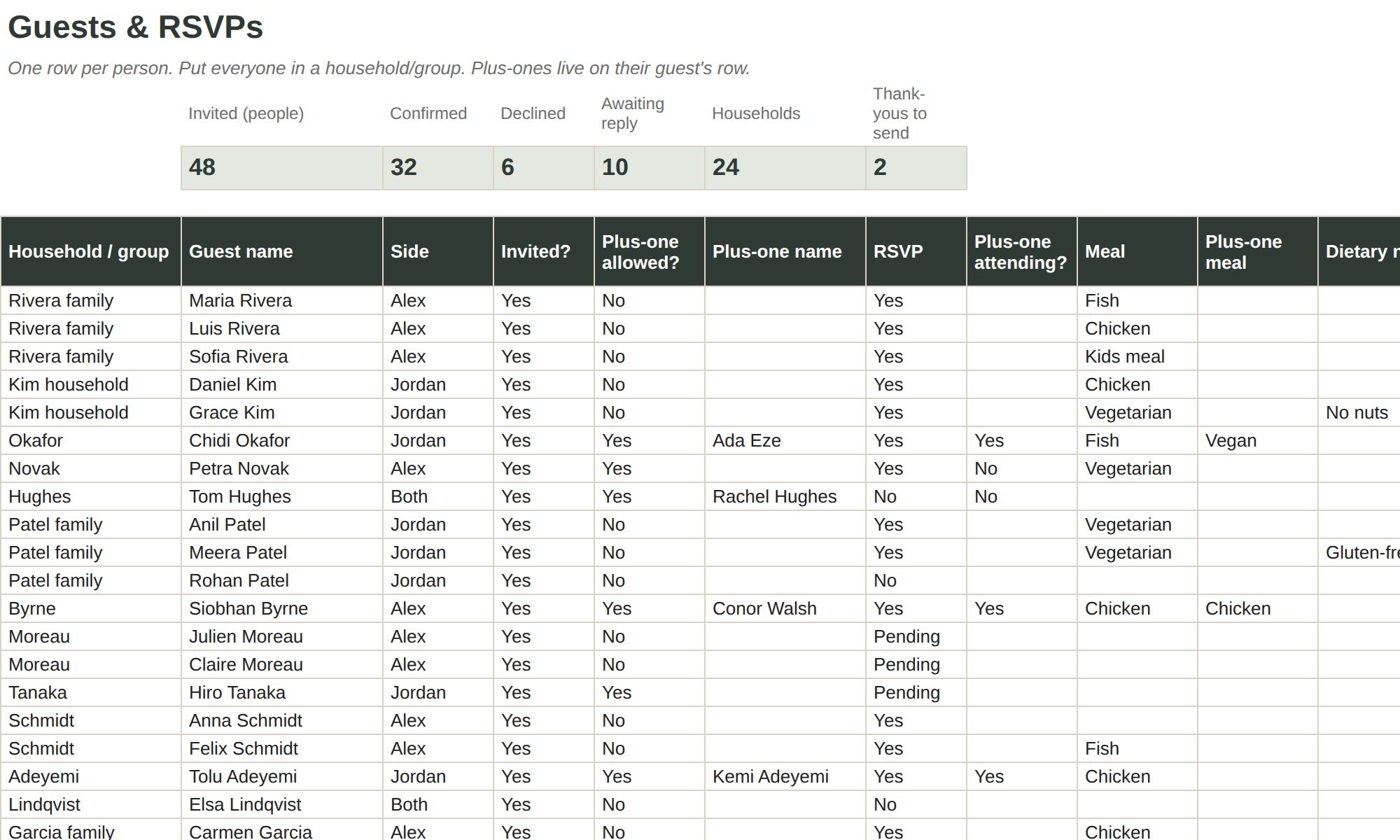
The Guests tab of the workbook, fictional example. Google Sheets and Excel.
Common questions
Who decides the wedding guest list?
The couple, first. Agree on the total and the split between you and each family before anyone writes names, then each side builds its list within its share.
Does the guest list have to be split equally between families?
No. The traditional split when both sets of parents contribute is half for the couple and a quarter for each family, but The Knot notes there is no rule that it has to be equal. Pick the split that fits who is paying and who you want there.
What percentage of invited guests attend a wedding?
The Knot's rule of thumb is 75 to 80% of invited guests. Start there and adjust for how many guests are traveling and when the wedding is.
When should you send invitations if you have a B list?
At least four months before the wedding, according to a planner in The Knot's guide, so there is time to invite B list guests as declines come in.
Sources
- The Knot, How to Make a Wedding Guest List, According to Experts: decide guest list with budget and location, the family "pie", the traditional 50/25/25 split and that it need not be equal, separate lists, B list and invitations at least four months out, plus-one rules, 75 to 80% attend.
- The Knot, What Percentage of Wedding Guests RSVP Yes: start with about 20% declining.
- The Knot, 2026 Real Weddings Study data read-out (PDF) and The Average Wedding Cost: 117 average guests, $292 per guest.
- Morrow & Made research: our read of 109 public wedding planning threads (2026), including the guest splits couples describe. Paraphrased; these are not customers.
Educational only. Photos are licensed stock images (Pexels); the people shown are not customers.