The short version
- Don't book anything in week one. Enjoy it and tell the people closest to you.
- Then settle three things, in this order: a budget range (and who is contributing), a guest count range, and a date window.
- Only then shortlist venues. The venue fixes your date and capacity, and every other vendor needs both.
- You have time. The average engagement in The Knot's 2026 study was 14 months.
What most couples do
If you feel pressure to start right away, you are in good company. The Knot's 2026 Real Weddings Study, a survey of more than 10,000 US couples married in 2025, found that most couples begin planning within weeks. They also have more time than it feels like.
Nearly 60% of couples start in less than a month
About 40% are engaged 11 to 18 months
Fall is the most popular season
Source: The Knot 2026 Real Weddings Study data read-out.
Engaged in the holidays? So are a lot of people
Share of proposals between Thanksgiving and Valentine's Day, from The Knot's 2026 study. That is why January is the busiest month for planning searches and venue tours.
Source: The Knot 2026 Real Weddings Study data read-out ("Around 40% of proposals take place between Thanksgiving and Valentine's Day").
The first 30 days, week by week
This is the order we would follow. Each step feeds the next one, which is why the venue comes last, not first.
- Week 1: enjoy it, and tell your people.Call family and close friends before posting. Get the ring sized and insured if it needs it. Book nothing yet, even if a venue has an "engagement special."
- Week 2: the money talk.Agree on a comfortable budget range, not a single number. Ask, gently and directly, whether anyone in your families wants to contribute and how much. Don't assume either way.
- Week 3: a guest count range.Each of you writes a quick list: must invite, would like to invite. Count both. That gives you a low and a high number, and the range is enough for now.
- Week 4: a date window, then a venue shortlist.Pick a season or a few months that work. Then look for venues that fit your guest range and budget range, and book two or three tours.

The money talk
Budget was the second thing couples cared about most while planning in The Knot's study, right after making sure guests have a good time. It is also the conversation people most often put off.
Start with a range. "Somewhere between $20,000 and $28,000" is easier to agree on than one number, and it leaves room for the quotes you haven't seen yet. To see where your range sits, compare it with the 2026 average and median wedding cost.
Ask about family help early. The Knot found that slightly more than half of couples had all or most of their wedding paid for by their parents. Plenty of couples pay for it themselves. Either way, knowing in month one beats finding out after you sign a venue contract. Our guide to who pays for what in a wedding has the five questions to ask.
Decide who tracks it. The Knot also found that one partner usually carries most of the planning. Agree now on who keeps the list, so you both can see it.
A guest count range
Guest count moves the budget more than anything else. It sets the catering bill, the bar, the rentals and which venues are big enough. A quick way to sanity-check your range is The Knot's 2025 average of $292 per guest. It is a rough national figure, not a quote, but it shows how fast the total moves.
The same $292 average at three guest counts
A rough planning check, not a quote. Fixed costs like the photographer and attire don't shrink with fewer guests, so a smaller wedding usually costs more than this per person.
Source: The Knot 2026 Real Weddings Study, $292 average cost per guest and 117 average guests. Multiplication is ours. Hover or tap a bar for the math.
View the numbers as a table
| Guests | × $292 |
|---|---|
| 80 | $23,360 |
| 117 | $34,164 |
| 150 | $43,800 |
If the high end of your guest range lands well above your budget range, that is useful to learn now, while nothing is booked. You can trim the list, pick a less expensive day or season, or move the budget. Our cost per guest guide goes further, including why cutting one guest saves less than $292.
Plan the venue for the high end of your range and the food for the RSVPs. The Knot suggests starting with an estimate that about 20% of invited guests will decline, then adjusting for travel and timing.
A date window, then the venue
You don't need an exact date yet. A season or a few candidate months is enough to start looking. Keep in mind that 76% of weddings in The Knot's study took place between May and October, so those Saturdays go first. A Friday, a Sunday or an off-season month widens your options and often lowers the price.
Once you have the three ranges, the venue is the first real booking. It locks your date and your capacity, and the photographer, caterer and everyone else will ask for both. Popular venues often book 12 to 18 months ahead, so starting tours in month one or two is reasonable.
| Bring to every venue tour | Why |
|---|---|
| Your guest count range | Ask the comfortable capacity, not the maximum. |
| Your budget range | Ask what is included, and what tax, service charges and minimums add. |
| Two or three candidate dates | Ask which are open and whether other days cost less. |
| The deposit question | Ask the amount, when the rest is due, and what happens if the date moves. |
Our vendor payment schedule guide covers deposits and final balances in detail.
What can wait
Almost everything that depends on the venue and the date. Choosing these first is how couples end up redoing them.
- Flowers, decor and color palette. They depend on the venue and the season.
- The cake, favors and signage. Months away.
- Most attire. Browse for fun, but dresses and suits are ordered after the date is set.
- Invitations. Save-the-dates come after the date and venue are booked.
Keep it in one place
By the end of month one you will have a budget range, a rough guest list, a few dates and a venue shortlist. Write them down somewhere you can both see. A shared document works. Our free First 30 Days guide walks through these steps, and when the deposits start, the Wedding Planning OS workbook connects the budget, guests, vendors and payments so the numbers stay in sync.
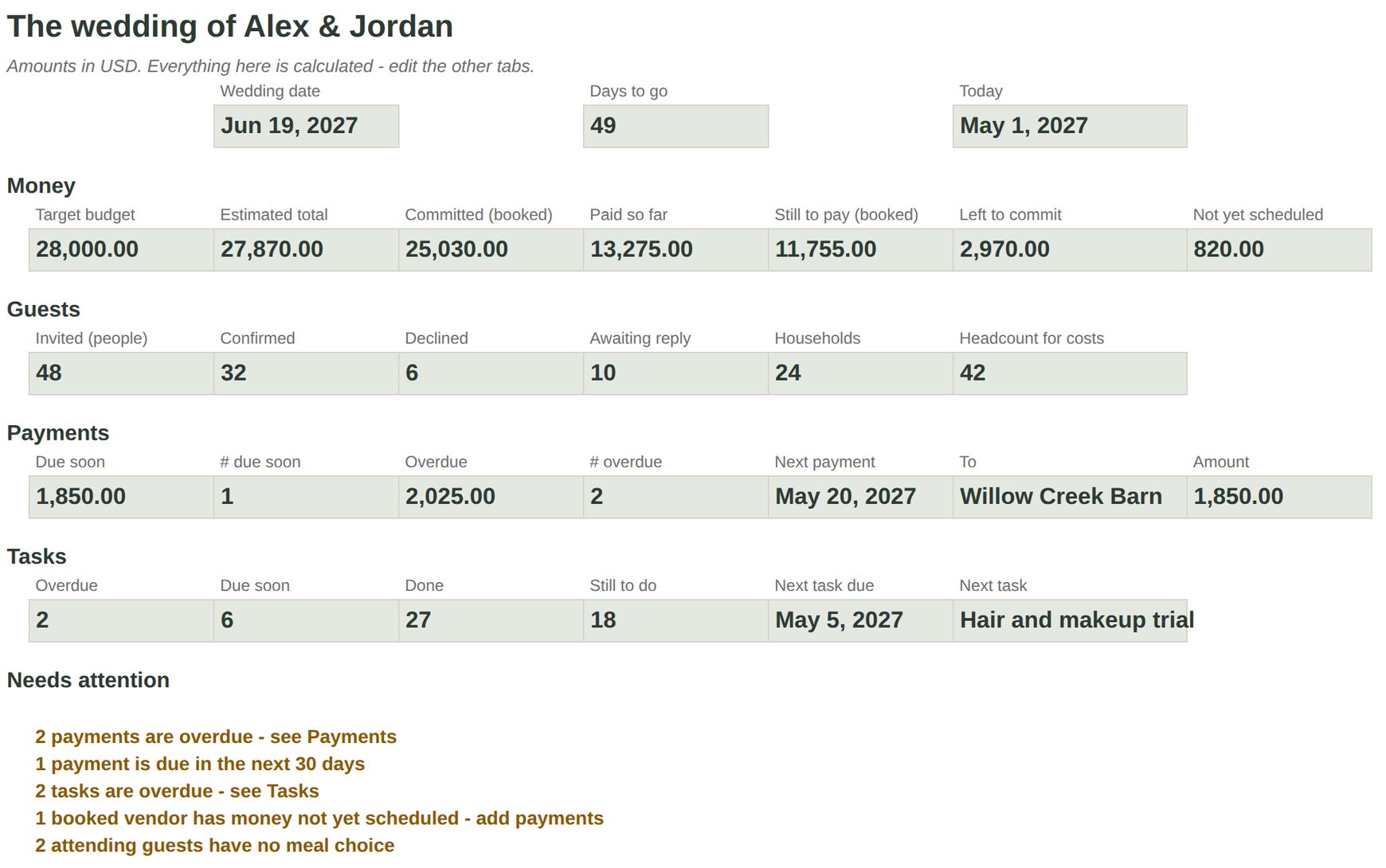
The Dashboard of the workbook, fictional example. Google Sheets and Excel.
Common questions
What should you do first after getting engaged?
Enjoy it and tell the people closest to you. Then, before booking anything, agree on three things in order: a budget range and who is contributing, a rough guest count range, and a date window or season. Those three decide which venues make sense.
How soon should you start planning a wedding after getting engaged?
There is no deadline, but most couples start quickly. The Knot's 2026 Real Weddings Study found that nearly 60% of couples start planning within a month of getting engaged, and the average engagement lasts 14 months.
What should you book first for a wedding?
Usually the venue, because it sets the date and the guest capacity that every other vendor needs. Popular venues often book 12 to 18 months ahead. Sign only after you have a budget range and a guest count range.
What can wait after you get engaged?
Almost everything that depends on the venue and the date: flowers, decor, favors, the cake and most attire. Picking these before the venue and budget are set often means changing them later.
Sources
- The Knot, 2026 Real Weddings Study data read-out (PDF): nearly 60% start planning within a month, 14-month average engagement, about 40% engaged 11 to 18 months, about 40% of proposals between Thanksgiving and Valentine's Day, 76% married May to October, planning priorities, one partner carrying most of the planning, slightly more than 50% with all or most paid by parents, 117 average guests.
- The Knot, The Average Wedding Cost: $34,200 average, $292 per guest.
- The Knot, What Percentage of Wedding Guests RSVP Yes: start by assuming about 20% decline.
- Shutter & Sound, When to Book Wedding Vendors: most venues book 12 to 18 months ahead.
Educational only. This is not legal, financial or tax advice. Photos are licensed stock images (Pexels); the people shown are not customers.