The short version
- In The Knot's 2026 data, venue and rentals take about 29% of the average budget and catering, cake and drinks about 24%. Together, more than half.
- Photo and video take about 10%, florals and decor about 9%, music and attire about 6% each.
- The percentages describe the average $34,200 wedding. On a small budget, fixed costs like a photographer take a bigger share.
- Keep at least 5% aside for surprises, as The Knot suggests. Service charges and tips are the usual ones.
- Use the percentages as a starting draft, then replace each line with real quotes as they come in.
The wedding budget breakdown by percentage
The Knot's 2026 Real Weddings Study surveyed 10,474 US couples married in 2025. The average total was $34,200, and this is how it divided up. For what that average leaves out, see average wedding cost in 2026.
Where the average wedding budget goes
Share of the average 2025 US wedding budget, by category. Hover or tap a bar for the dollar amount at the $34,200 average.
Source: The Knot, The Wedding Budget Breakdown You Need (2026 Real Weddings Study). The shares are rounded, so they add up to about 100%. The Knot lists the planner at 5% in its summary and 4% in its detail. Dollar amounts are our multiplication, not quotes.
Two lines decide most of the budget. The venue and the food together are more than half of it, and both depend on how many guests you invite. That is why the guest count and the venue are among the first decisions in our free First 30 Days guide.
The same breakdown in dollars at four budget sizes
Here is what those shares come to at $10,000, $20,000, the $34,200 average and $50,000. It is simple multiplication, rounded to the nearest $100. Use it as a first draft, not a price list.
| Category | Share | $10,000 | $20,000 | $34,200 | $50,000 |
|---|---|---|---|---|---|
| Venue and rentals | 29% | $2,900 | $5,800 | $9,900 | $14,500 |
| Catering, cake and drinks | 24% | $2,400 | $4,800 | $8,200 | $12,000 |
| Photo and video | 10% | $1,000 | $2,000 | $3,400 | $5,000 |
| Florals and decor | 9% | $900 | $1,800 | $3,100 | $4,500 |
| Music | 6% | $600 | $1,200 | $2,100 | $3,000 |
| Attire and beauty | 6% | $600 | $1,200 | $2,100 | $3,000 |
| Wedding rings | 5% | $500 | $1,000 | $1,700 | $2,500 |
| Wedding planner | 5% | $500 | $1,000 | $1,700 | $2,500 |
| Guest entertainment | 3% | $300 | $600 | $1,000 | $1,500 |
| Transportation | 2% | $200 | $400 | $700 | $1,000 |
| Stationery | 1% | $100 | $200 | $300 | $500 |
| Officiant | 1% | $100 | $200 | $300 | $500 |
Shares from The Knot 2026 Real Weddings Study. Dollar columns are our multiplication, rounded. They are not quotes and not data about real weddings at those budgets.
Why the percentages break on a small budget
The breakdown is a picture of the average wedding. Your budget is not the average, and some costs do not shrink when the total does. The Knot also publishes average prices for single vendors. Put them next to a $10,000 budget and the problem is easy to see.
30% of a $10,000 budget, not 10%
Per person. 100 guests is $8,000
More than the whole $10,000
Source: The Knot, The Average Wedding Cost (2026 Real Weddings Study). The percentages of $10,000 are our math. These averages come from couples who hired that vendor, so they do not line up exactly with the shares of the total.
Here is a quick check at $20,000 with 100 guests. The catering share is $4,800, or $48 a guest, against The Knot's $80 average per person before drinks, cake or service charges. One of three things has to give: a smaller guest list, a bigger catering share, or a different style of meal. Our cost per guest guide walks through that math with your own quotes.
On a small budget, the usual move is not to shrink every line by the same amount. It is to cut guests, which lowers the per-guest lines, or to drop whole categories, like a planner, transportation or extra entertainment, so the ones you keep can be done properly.
Move money to what you care about
The percentages say what couples spent on average, not what you should spend. If photos matter most to you, give photography 15% and take it from somewhere you care less about. A simple way to do it:
- Each of you picks your top three.Separately, then compare. The overlap gets protected.
- Pick two lines to keep small.Categories neither of you will remember, or that a friend or family member could cover.
- Move the money on paper.Raise the protected lines and lower the small ones until the total still matches your budget.
- Write the new shares down.They become your estimates. Every quote gets compared against them.
Haven't talked about who pays for what yet? Our free First 30 Days guide covers that conversation, along with the first three decisions: budget, guest estimate and venue.
What the percentages leave out
A few costs hide outside the categories, and they are where budgets usually go over.
- Service charges. The Knot says a venue or caterer service charge typically runs 20 to 25% of the food and drink total. On an $8,200 catering line, that is roughly another $1,600 to $2,000.
- Tips. Many vendors are tipped on the day, and some contracts already include gratuity. Read the contract before you budget it twice.
- Tax and delivery fees. Quotes do not always include them.
- A buffer. The Knot suggests setting aside at least 5% of the budget for unforeseen costs. On $20,000, that is $1,000.
The simplest fix is to take the buffer off the top. Budget $19,000 of a $20,000 total across the categories and hold $1,000 back.
From percentages to real quotes
A percentage breakdown is only the first version of your budget. Once quotes arrive, each line should change from an estimate to the price you actually signed for, and later to what you have paid. Couples in planning threads describe that last step as the hard part: a deposit that never made it into the total, or two people each thinking the other had paid.
Our Wedding Planning OS workbook keeps those numbers apart on its Budget tab. Each category has an estimate, the amount committed in a signed contract, the amount paid and what is still to pay, and the per-guest lines follow your headcount. The budget planner guide explains the four numbers.
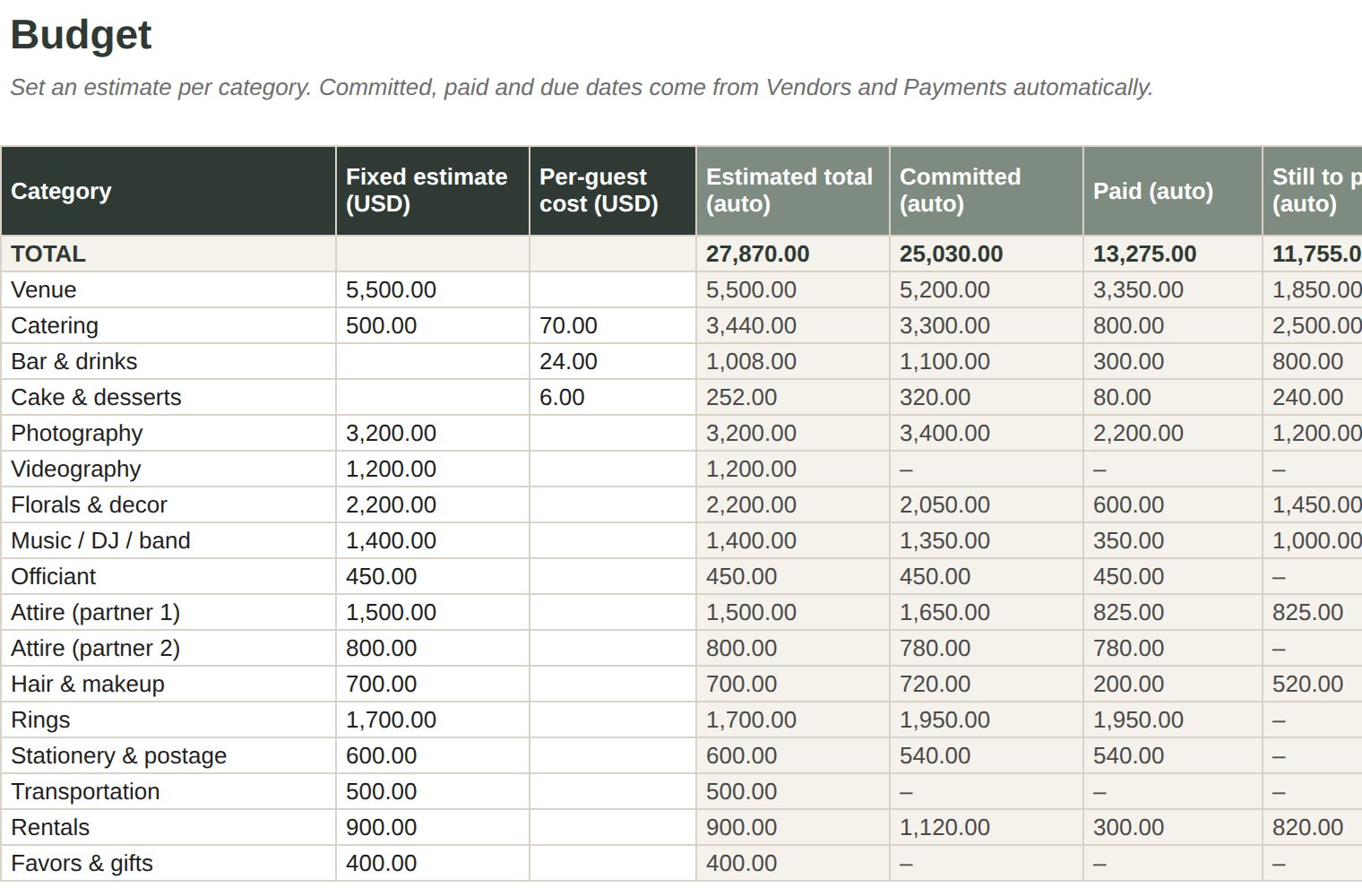
The Budget tab of the workbook, fictional example. Google Sheets and Excel.
Common questions
What percentage of a wedding budget goes to the venue?
About 29% for the venue and rentals, according to The Knot 2026 Real Weddings Study. Catering, cake and drinks take about 24%, so the two together are more than half of the average budget.
What percentage of a wedding budget should go to photography?
About 10% for photography and videography together in The Knot's 2026 data. The average photographer alone cost $3,000, which is 30% of a $10,000 budget, so on a small budget the share is usually higher.
How much should you keep for unexpected wedding costs?
The Knot suggests setting aside at least 5% of the budget for unforeseen costs. Service charges, which The Knot says typically run 20 to 25% of the food and drink total, and vendor tips are two common surprises.
Do wedding budget percentages work for a $10,000 wedding?
Only roughly. The percentages describe the average $34,200 wedding. Some costs, like a photographer or attire, do not shrink with the budget, so a smaller wedding usually spends a bigger share on them and saves by cutting guests or whole categories.
Sources
- The Knot, The Wedding Budget Breakdown You Need, Backed By Data (updated Jun 24, 2026): category shares from the 2026 Real Weddings Study, service charges of 20 to 25% of food and drink, at least 5% set aside for unforeseen costs.
- The Knot, The Average Wedding Cost: $34,200 average, 117 guests, $292 per guest, and single-vendor averages (reception venue $12,900, photographer $3,000, catering $80 per person).
- The Knot, 2026 Real Weddings Study data read-out (PDF): 10,474 US couples married in 2025.
- Morrow & Made research: our read of 109 public wedding planning threads (2026), including deposits missing from totals and partners unsure who paid. Paraphrased; these are not customers.
- Dollar columns, the $20,000 example and the workbook screenshot are our math or our fictional sample wedding. They are not data about real weddings.
Educational only. This is not financial advice. Your contracts and quotes decide what you owe. Photos are licensed stock images (Pexels); the people shown are not customers.