The short version
- Track four numbers: estimated (your plan), committed (signed contracts), paid (money out) and still to pay (committed minus paid).
- Paid plus still to pay should equal committed. If it does not, a payment is missing from your list.
- In our fictional example, a $29,920 estimate has $25,030 committed, $13,275 paid and $11,755 still to pay.
- Estimates are guesses. The gap between estimate and committed is the information, so do not overwrite the estimate when you sign.
The four numbers
Most budget templates have a column for what you planned and a column for what you spent. That leaves a hole in the middle: money you have promised but not yet paid. A deposit is paid, the balance is committed, and the line you have not booked yet is only an estimate. Each is a different kind of knowing.
| Number | The question it answers | Where it comes from | In our example |
|---|---|---|---|
| Estimated | What do we expect to spend? | Your guess for each category: fixed cost plus per-guest cost × guests. | $29,920 |
| Committed | What have we signed for? | The contract total of every vendor you have booked. | $25,030 |
| Paid | What has actually left the account? | Every payment that has a paid date. | $13,275 |
| Still to pay | What do we owe on what we signed? | Committed minus paid. | $11,755 |
One estimate, split three ways
The same fictional $29,920 estimate, split by what has happened to the money so far.
Fictional example from the Wedding Planning OS sample workbook, 42 confirmed guests. Paid plus still to pay equals committed ($13,275 + $11,755 = $25,030).
About a sixth of the estimate is still only a guess ($4,890, the part of the estimate with no contract behind it). Another $11,755 is promised and not yet paid. Only $13,275 has left the account. A tracker that shows one number cannot show you that.
Why one number is not enough
Couples in public wedding forums describe the same few problems, and they all come from blurring the four numbers together.
| What a couple wrote | The problem |
|---|---|
| “we know the amount is off by $300, give or take.” | Small spending slips out of the total |
| “I think it will be about $20G over” | Not knowing the total until the end |
| “we’re on a super tight budget which keeps shrinking thanks to unexpected bills” | Costs that were never a line |
| “it helps alot, i can see how much i have left to pay” | What a tracking sheet is for |
| “I made all my final payments at 30 days out and it hit hard!” | The still-to-pay number arriving all at once |
Individual couples in public forum threads (Weddingbee, WeddingWire), read Oct 11, 2026. Anecdotal, not a survey.
For scale, a LendingTree survey of 1,050 US newlyweds, fielded in March 2025, found that about two in three (67%) took on debt to pay for the wedding. It is one survey of one group, but it is the reason to see the full picture before the final payments arrive.
The pattern is steady. Small spending slips out of the total, the real number shows up late, and the final balances land in the same few weeks. Our guide to when vendor payments are due shows how much of the money can fall in the last two months.
A filled example, category by category
The fictional wedding below has 42 confirmed guests (48 invited, 6 declined), 22 budget categories and 15 booked vendors. Here is how eleven of the categories stand. Each category has its own estimate, its own contract and its own payments, so each has its own four numbers.
Eleven categories, estimate against reality
Each bar shows where the money stands against the category estimate (the number on the right). Dark is paid, gold is signed but still owed, hatched is not yet committed. Hover or tap a bar for its numbers.
Fictional example from the sample workbook. The number at the right is the category estimate.
View all 22 categories as a table
| Category | Estimated | Committed | Paid | Still to pay |
|---|---|---|---|---|
| Venue | $5,500 | $5,200 | $3,350 | $1,850 |
| Catering | $3,440 | $3,300 | $800 | $2,500 |
| Bar & drinks | $1,008 | $1,100 | $300 | $800 |
| Cake & desserts | $252 | $320 | $80 | $240 |
| Photography | $3,200 | $3,400 | $2,200 | $1,200 |
| Videography | $1,200 | · | · | · |
| Florals & decor | $2,200 | $2,050 | $600 | $1,450 |
| Music / DJ / band | $1,400 | $1,350 | $350 | $1,000 |
| Officiant | $450 | $450 | $450 | · |
| Attire (partner 1) | $1,500 | $1,650 | $825 | $825 |
| Attire (partner 2) | $800 | $780 | $780 | · |
| Hair & makeup | $700 | $720 | $200 | $520 |
| Rings | $1,700 | $1,950 | $1,950 | · |
| Stationery & postage | $600 | $540 | $540 | · |
| Transportation | $500 | · | · | · |
| Rentals | $900 | $1,120 | $300 | $820 |
| Favors & gifts | $400 | · | · | · |
| Planner / coordinator | $1,200 | $1,100 | $550 | $550 |
| License & fees | $120 | · | · | · |
| Contingency | $800 | · | · | · |
| Tax & service charges | $1,600 | · | · | · |
| Tips & gratuities | $450 | · | · | · |
| Total | $29,920 | $25,030 | $13,275 | $11,755 |
The videographer in the example quoted $2,100 against a $1,200 estimate. It is not booked, so it is not in the committed total. But it sits in the vendor list, and the $4,890 not yet committed does not cover it. Seeing that gap before you sign is the point of keeping estimated and committed apart.
Estimates are guesses, and it shows. In the example, 7 booked categories came in above their estimate (by $1,000 in total) and 7 came in below (by $820). Neither is a mistake. The estimate was a plan, and the contract is the fact.
Notice also the two lines at the bottom of the estimate that most budgets forget: tax and service charges ($1,600) and tips and gratuities ($450). Couples in the threads we read name tips and hidden extras more than any other line they wish they had budgeted.

Set it up in five steps
- List your categories.Venue, catering, bar, cake, photography, flowers, music, attire, rings, stationery, transportation, rentals and the rest. Add tax and service charges, tips, and a contingency line now, not later. Our free First 30 Days guide lists what goes on top of a quote.
- Write an estimate for each one.For per-guest items, enter the price for one guest and multiply by your expected headcount. Fixed items get a flat number. Our guide to cost by guest count shows the formula.
- When you sign, record the contract total.Put it in a separate column. Leave the estimate alone, so the gap between the two stays visible.
- Give every payment its own row.A deposit, an installment and a final balance are three rows, each with a due date. Leave the paid date empty until you pay.
- Check the sum once a month.Paid plus still to pay should equal committed. If it does not, a payment is missing.
How to read the gaps
- Estimate minus committed. Positive means room left in that category, negative means it came in over. Add the positive and negative gaps across categories to see whether the plan is holding.
- Committed minus paid. This is the money you still owe on signed contracts. Compare it with the cash you have set aside. If some of that cash is promised by family, count only what has arrived: see who pays for what.
- Not yet committed. Categories with no contract are the ones where a quote can still surprise you. Get those quotes early.
- Still to pay by month. The total matters less than when it is due. The payment calendar in our payments guide shows why the last month is usually the heaviest.


Our Wedding Planning OS workbook builds this into the Budget tab. You enter an estimate for each category and a contract total on the Vendors tab, and it fills in committed, paid and still to pay from the Vendors and Payments tabs. The Dashboard shows the totals. Everything on this page that comes from the demo is a fictional wedding.
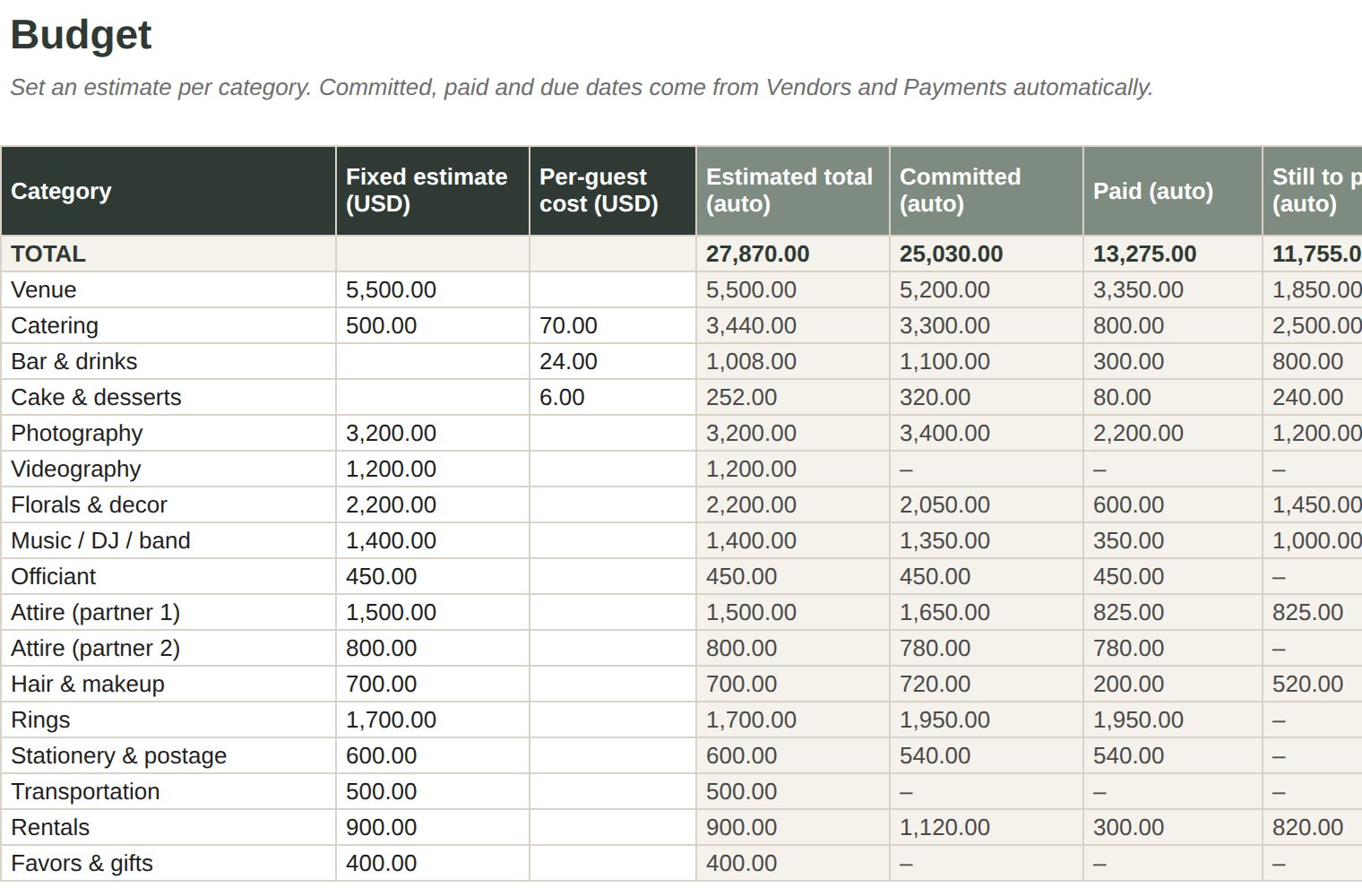
The Budget tab of the workbook, fictional example. Google Sheets and Excel.
Common questions
What is the difference between estimated and committed?
Estimated is your plan: what you expect to spend in each category before you have signed anything. Committed is what you have actually agreed to pay, which is the contract total of each vendor you have booked. A quote is not committed until you sign.
What should a wedding budget include?
The big vendor categories, but also the lines that get forgotten: tax and service charges on catering and venue, tips, attire alterations, postage, and a contingency line. Couples in planning forums mention tips and hidden extras most often as the lines they wish they had budgeted for.
How do I set a per-guest cost in a budget?
List the costs priced per person (catering, bar, cake, rentals), write down the price for one guest, and multiply by your expected headcount. The fixed costs go in a separate column. Our guide to cost by guest count walks through it.
Should I track small purchases?
Couples disagree. Some write down every purchase and keep every receipt. Others only track big items and do not count the little things. If you skip small items, a contingency line gives them somewhere to land.
How much should I keep for contingency?
There is no standard. Our fictional example keeps $800, about 3% of the $29,920 estimate, as its own line. Pick a figure you are comfortable with and keep it visible so it does not quietly become spending money.
Can I use a spreadsheet instead of an app?
Yes. Excel dominates in the planning threads we read, including for couples who use apps for everyday money. What matters is that the sheet keeps the four numbers apart and that every payment has its own row.
Sources
- Weddingbee boards, “Did you actually track your wedding budget/spending?”: tracking habits, an estimate off by $300, tips unbudgeted. Read Oct 11, 2026.
- WeddingWire forum, “How are you keeping track of your expenses and budget?”: spreadsheets, tabs per category, tracking only big purchases. Read Oct 11, 2026.
- WeddingWire forum, “Financial stress!”: final payments at 30 days and paying balances early to soften the end. Read Oct 11, 2026.
- LendingTree newlywed survey (1,050 US newlyweds, fielded March 12 to 19, 2025, published April 28, 2025), as reported by FOX 5 Atlanta: about two in three took on debt.
- The chart, tables and worked numbers use the fictional sample wedding included with Wedding Planning OS (42 confirmed guests). They are an example of a budget, not data about real weddings.
Educational only. This is not legal, financial or tax advice. Your contracts decide what you owe and when. Forum posts are individual experiences. Photos are licensed stock images (Pexels); the people shown are not customers.